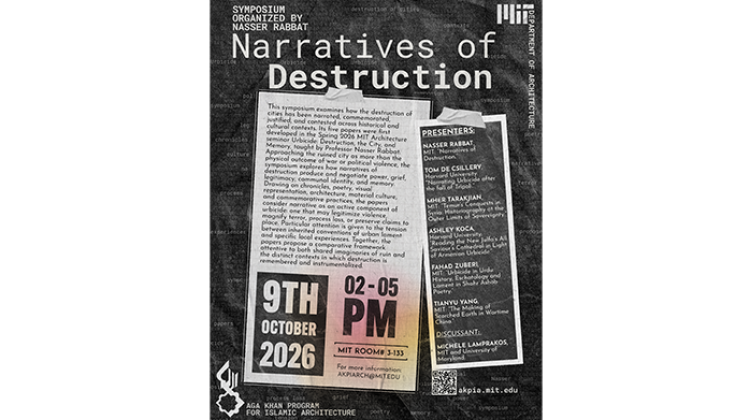
Fall 2026 AKPIA Lecture Series: An Evening With: A Symposium organized by Professor Nasser Rabbat: Narratives of Destruction

Please join us on Friday October 9th  when

The Aga Khan Program Fall 2026: An Evening With Lecture Series presents: A Symposium organized by Professor Nasser Rabbat: Narratives of Destruction

2 pm in 3-133 

Free and open to the public

In person or live stream

Nasser Rabbat, MIT: “Narratives of Destruction.”

Tom De Csillery, Harvard University: “Narrating Urbicide after the fall of Tripoli.”

Mher Tarakjian, MIT: "Temur’s Conquests in Syria: Historiography at the Outer Limits of Sovereignty.”

Ashley Koca, Harvard University: “Reading the New Julfa’s All Savior’s Cathedral in Light of Armenian Urbicide.” 

Fahad Zuberi, MIT: “Urbicide in Urdu: History, Eschatology and Lament in Shahr Ashob Poetry.”

Tianyu Yang, MIT: “The Making of Scorched Earth in Wartime China.”

Discussant: Michele Lamprakos, MIT and University of Maryland

Bio’s 

Nasser is the Aga Khan Professor and Director of the Aga Khan Program for Islamic Architecture at MIT.  His interests include Islamic art and architecture, urban history, heritage studies, Arab history, contemporary Islamic art, and post-colonial criticism.  He teaches lecture courses on various aspects of Islamic architecture and seminars on Orientalism and colonialism; Issues in Islamic Urbanism; Colonial Cities; Historiography of Islamic Architecture; Late Antiquity and the foundation of Islamic architecture; Reading Ibn Khaldun; (Re)constructing Memory; Urbicide; and Balancing Globalism and Regionalism in the Arabian Gulf.

Professor Rabbat has published numerous articles and several books on topics ranging from Mamluk architecture to Antique Syria, 19th century Cairo, Orientalism, and urbicide.  His most recent books are Reconstruction as Violence in Assad's Syria, co-edited with Deen Sharp (2025); Turathuna: Nazarat wa-Araa’ fi al-‘Imara wal-Tarikh (Our Heritage: Viewpoints on Architecture and History) (2025); Taqiy al-Din al-Maqrizi: Wijdan al-Tarikh al-Masri (Taqiy al-Din al-Maqrizi: The Soul of Egyptian History) (2024), which won the Second Prize, History Section of the Arab Book Award 2025, Doha, Qatar; Nasser Rabbat: Critical Encounters (2023); Writing Egypt: Al-Maqrizi and His Historical Project(2023), which won the 2024 British-Kuwaiti Friendship Society Prize in Middle Eastern Studies; and ‘Imarat al-Mudun al-Mayyita (The Architecture of the Dead Cities) (2018).  He is currently writing a history of Mamluk Cairo, a historical novel situated in 13th-century Damascus, and editing a book on the cultural history of Syria, tentatively entitled, Syria: A Continuous Cultural Palimpsest.

He has previously published: an online book co-edited with Pamela Karimi, The Destruction of Cultural Heritage: From Napoléon to ISIS,  (2016); al-Naqd Iltizaman (Criticism as Commitment) (2015); Mamluk History Through Architecture: Building, Culture, and Politics in Mamluk Egypt and Syria (2010), which won the British-Kuwait Friendship Society Prize in Middle Eastern Studies, 2011, Thaqafat al Bina’ wa Bina’ al-Thaqafa (The Culture of Building and Building Culture) (2002), and The Citadel of Cairo: A New Interpretation of Royal Mamluk Architecture. He edited The Courtyard House between Cultural Reference and Universal Relevance (2011), co-edited Making Cairo Medieval (2005), and co-authored Interpreting the Self: Autobiography in the Arabic Literary Tradition (2001).  

Prof. Rabbat worked as an architect in Los Angeles and Damascus and held several visiting academic appointments including the Ludwig-Maximilians-Universität, Munich in 2007; École des hautes études en sciences sociales (EHESS), Paris in 2009; New York University in Abu Dhabi, UAE in 2019, 2020, and 2022; and the Academy of the Kingdom of Morocco, Rabat in 2025.  He was elected to the American Academy of Arts and Sciences in 2025 and has received various recognitions including The 2025 Best Arabic Book Award in History from Qatar; an Honorary Award for Good Practices in Cultural Heritage Conservation from the International Centre for the Study of the Preservation and Restoration of Cultural Property-Sharjah (ICCROM), UAE; the Best Middle Eastern Studies Book Award from the British-Kuwaiti Friendship Society, London in 2024 and 2011; the J. Paul Getty Center, Los Angeles in 2023 ad 1993-94; the Villa I Tatti, Florence in 2022 and 2026; the American Academy in Rome in 2018; the Institut d’études avancées, Paris in 2016; the Annemarie Schimmel Kolleg, University of Bonn in 2015, 2017 and 2018; the Radcliffe Institute for Advanced Study, Cambridge, MA in 2011-12; the American Research Center in Egypt (ARCE) in 2007-2008, 2000, and 1989; the Institut Français d’Archéologie Orientale (IFAO), Cairo in 2008; and l’Institut du Monde Arabe (IMA), Paris in 2002.  He contributes to several Arabic newspapers and e-zines, serves on the boards of various cultural and educational organizations, and consults with international design firms on projects in the Islamic World.  Professor Rabbat served as a member of the 2019 and the 2022 Steering Committee of the Aga Khan Award for Architecture. 

Mher is a second-year doctoral student in the History, Theory, and Criticism of Architecture and Art program at MIT. His research focuses on mapping architectural narratives and their participation in property regimes, drawing from legal archives to contextualize the intersections of political ideologies, aesthetic production, and broader cultural conventions. He holds a Bachelor of Architecture from the University of Aleppo and recently earned a Master in Design Studies with distinction from Harvard University’s Graduate School of Design. Prior to beginning his doctoral studies, Mher practiced architecture in New York City, Paris, and Aleppo. He is a licensed architect in the state of New York.

Ashley is a second year AM candidate at Harvard University’s Center for Middle Eastern Studies. She graduated from Cornell University as a Robert S. Harrison College scholar in the History of Art and Near Eastern Studies. She is interested in theories of reception, particularly as they relate to questions of the use and reuse of shared motifs, material, and architectural morphologies across confessional lines. Her thesis will focus on aesthetic cosmopolitanism and anxieties over communal integrity in New Julfa.

Fahad is an academic and columnist, currently pursuing PhD at MIT's Department of Architecture HTC. His work focuses on the intersection of architecture and violence, particularly in South Asian contexts. Fahad studied B. Arch at Aligarh Muslim University, an M. Arch HTC at CEPT University, Ahmedabad, and then pursued an MSc in Modern South Asian Studies at University of Oxford as the Indira Gandhi Radhakrishnan Scholar with Oxford India Centre for Sustainable Development where he was awarded the Archibald Jackson Prize 2024 and Scholars Development Award 2024 for his work on Domicide.

Fahad has taught Architecture and Design Philosophy at CEPT University and at National Institute of Design in Ahmedabad as a visiting faculty and is a columnist and political commentator with several Indian platforms such as The Indian Express, The Hindu, The Wire and The Hindustan Times. Fahad has also worked as a comics journalist, in electoral politics, and seldom composes music. He is the Producer of Mutant: The Democracy Podcast -- conceived as a contemporary dictionary of politics -- with Institute of New Global Politics, Cal Poly Pomona and his first feature length film as a Music Director - Kayo Kayo Colour? - premiered at IFF, Rotterdam 2023.

Tianyu is a first-year PhD student and a writer-researcher in art and architecture, formerly based in Brooklyn, New York. She holds two advanced degrees from Columbia University in Architecture and in Critical, Curatorial, and Conceptual Practices (CCCP). Before coming to MIT, she co-taught an advanced design studio and history seminars at Columbia, developed a research-based monograph for a New York architecture studio, and contributed to Artforum. Her current research examines the politics of architectural representation, criminalistics, and environmental governance, asking how space mediates questions of power, evidence, and the state.

 Trained as an architect and historian, Michele Lamprakos’s career has combined teaching, research, and practice in architecture, heritage, and community development. Her research focuses on two main themes: the lives and layers of buildings and sites; and the entangled histories of Islam and Christianity in the Mediterranean.  

Lamprakos’ forthcoming book, Memento Mauri: the Afterlife of the Great Mosque of Cordoba  (spring 2027) explores that building’s changing fabric and meaning as cathedral, historic monument, and symbol of the Islamic past in Spain. Her first book, Building a World Heritage City: Sanaa Yemen, was recognized by the Society of Architectural Historians’ Spiro Kostof Award (Honorable Mention, 2018). Her research has been supported by the National Endowment for the Humanities, the Center for Advanced Study in the Visual Arts/National Gallery of Art, Washington DC,  the National Humanities Center, the Graham Foundation, and other institutions. 

Lamprakos lectures widely and has co-organized symposia and panels, including “Heritage and the Arab Spring” (Freer Gallery of Art, 2014) which explored the role of cultural heritage in a shifting Middle East.  Her courses at MAPP include “Islam in Africa: architecture and culture”; a two-part sequence on Mediterranean cities; and two thematic graduate seminars: “Adaptation” and “Destruction, Memory, Renewal.” She also teaches design studios and directs thesis projects on historically layered sites in the US and abroad.

In fall 2026, Lamprakos will be Visiting Associate Professor in the Aga Khan Program in Islamic Architecture at MIT’s School of Architecture and Planning. She has also held academic appointments at Duke University, the University of Pennsylvania, and other institutions.

Her professional work has included design and preservation for buildings that range in scale from tobacco warehouses to prewar single-family houses.  She has served as Technical Reviewer for the Aga Khan Award for Architecture and as Desk Reviewer for UNESCO.