





Fall 2026 AKPIA Lecture Series: An Evening With: Valentina Grassl
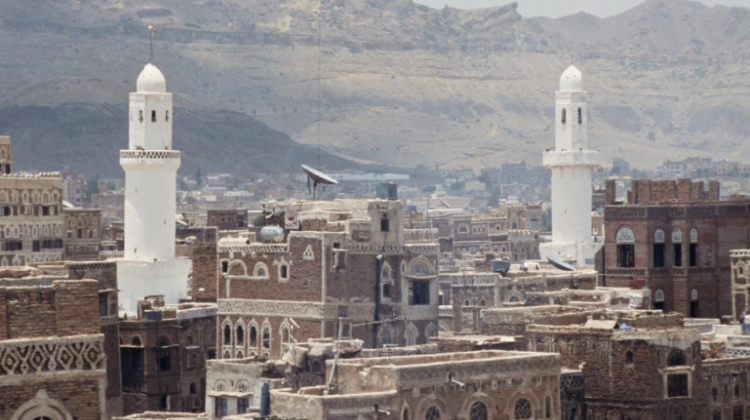
Photo: San'a', Yemen. From Taj Talha Hotel towards Great Mosque. Taken on July 1997 by Garth Fowden.
Free and open to the public
A Red Sea Pan-Culture from Almaqah to Allah: Pagan Temples, Christian Churches, and the Great Mosque of Sana’a
Valentina Grassl
Bio
Valentina is Assistant Professor of Medieval History at Bard College. She previously taught at The Catholic University of America in the Department of Semitic and Egyptian Languages and Literatures and at New York University’s Institute for the Study of the Ancient World. She was also an affiliate member of the European Research Council (ERC) project “The Qur’an as a Source for Late Antiquity”, and participated in archaeological projects in Iraqi Kurdistan, Sicily, Ethiopia, and Jordan.Her doctoral dissertation at the University of Cambridge was published as a monograph, Pre-Islamic Arabia: Societies, Politics, Cults, and Identities during Late Antiquity (Cambridge University Press, 2023). Her work on the Red Sea, Central Asia and Sicily in the ancient and medieval period has been featured in The Journal of Near Eastern Studies, The Journal of Late Antiquity, Millennium, The Journal of Ancient Near Eastern History and The Journal of Medieval Religious Cultures among others. She is currently editing Moving (Indian) Images in the First Millennium: papers from “Indian Ocean Figures that Sailed Away” an ISAW workshop series, spring 2022(Brepols) and finishing her second monograph on a Red Sea pan-culture encompassing aesthetic and religious practices.
Abstract
The emergence of Islam in South Arabia called for new communal gathering spaces. Instead of seeking fresh quarries, the masons salvaged columns from the ruined Church of Abraha—a sixth-century cathedral constructed specifically to rival Mecca—and integrated them into the structure of what would later become the Great Mosque of Sana’a. Excavations at Beta Samati in Ethiopia confirm a similar palimpsest two centuries earlier, during the spread of Christianity in the Horn of Africa. There, Christian basilicas adapted pagan predecessors, thereby re-adapting ancient carving techniques, plans, and motifs traceable to South Arabia. This presentation is structured in two parts. The first examines the historical context of late antique South Arabia: early contacts with the Horn of Africa, the emergence of a unified political entity under Himyar, the Aksumite conquest at the time of the so-called Massacre of Najran, and, eventually, Caliphal rule. The second part turns to the region’s visual culture and religious architecture, ranging from pagan temples and synagogues to churches and mosques. Drawing on my forthcoming monograph on cross-cultural interaction across the Red Sea, I argue for the existence of a Red Sea pan-culture encompassing both aesthetic and religious practices, demonstrating that the rise of Islam did not abruptly terminate South Arabia’s ancient aesthetic traditions. In the Great Mosque of Sana’a, for instance, the reuse of pre-Islamic structural and decorative elements and masonry techniques points to a desire to amalgamate rather than erase the past. Moreover, the plans of some early mosques bear a striking resemblance to ancient South Arabian pagan temples, such as the temple of Sirwah, dedicated to Almaqah.