





Spring 2026 AKPIA Lecture Series: An Evening With: Elizabeth Rauh
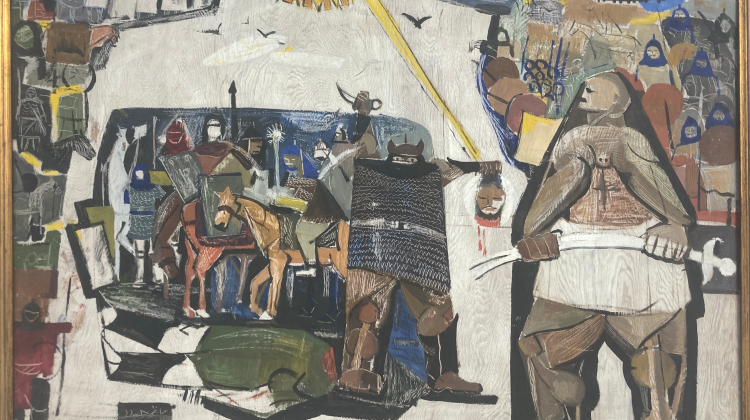
Photograph by Elizabeth Rauh (2023) courtesy of the Iraq Ministry of Culture
Free and open to the public
“I Light Fire to the Tradition" – Radical Art Practices in 1960s Iraq
Elizabeth Rauh
Bio
Elizabeth Rauh is Assistant Professor of Modern Art History and Visual Cultures at The American University in Cairo (AUC). Specializing in the history of arts and visual cultures of Iraq, Iran, and the Persian Gulf, her scholarship examines modern artist engagements with Islamic traditions, popular image practices and technologies in the Islamic world, and arts of the 1960s “Shi‘i Left.” She also pursues research in ecological art practices across the Gulf’s biodiverse environments. She is a 2025-2026 Postdoctoral Research Fellow at the Aga Khan Program for Islamic Art & Architecture at MIT in support of her first book project, “Lighting Fire to Tradition: 1960s Artist Experiments in the Islamic World.”
Abstract
With the establishment of the Tehran Biennale in 1958 and the 1974 Biennale of Arab Art in Baghdad, artists in the region increasingly participated in transnational art movements at a time when Islamic artistic heritage was dissipating due to expanding modernization and foreign domination in the Middle East. Yet contrary to common assumptions, modern artists have steadily experimented with Islamic traditions to generate avant-garde artworks and radical concepts drawn from revitalizing historical and religious practices.
Following the 1963 Ba'ath Party-led coup d’état of the Republic of Iraq and assassination of Prime Minister Abd al-Karim Qasim, artists in Iraq responded by producing new artworks and public events. Keenly aware of the powerful mobilizing forces and emotional resonances of Shi`i mourning ceremonies, artists in Iraq sought to wield popular religious mythologies into new symbolic registers and creative experiments in the face of entrenched colonialism and encroaching authoritarianism. Turning to sacred traditions, such as the Battle of Karbala, and popular votive materials, including amuletic motifs or depictions of the Prophet Muhammad’s Night Journey (miʿraj), artists enlisted Islamic traditions as critical grounds for artmaking and participating in both local political challenges and a globalizing art world. Such revival or “re-activation” of sacred content into contemporary artmaking reveals how political resistance comingled with Islamic traditions in 1960s Iraq.