





Exhibition: Beyond Data-Driven Aesthetics
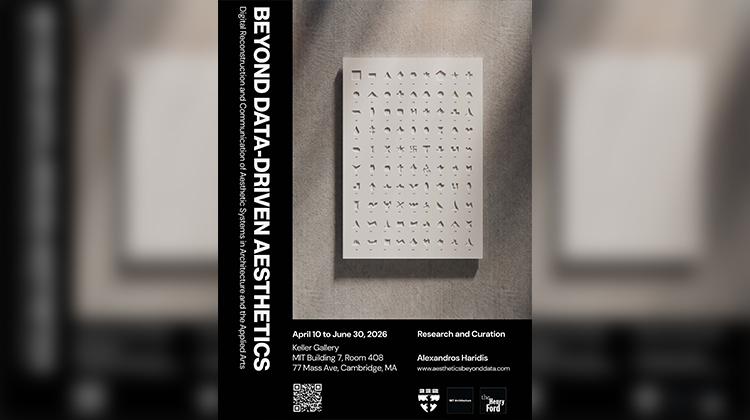
BEYOND DATA-DRIVEN AESTHETICS
Press Release
Cambridge, MA, March 31, 2026
The Massachusetts Institute of Technology announces that Beyond Data-Driven Aesthetics: Digital Reconstruction and Public Communication of Aesthetic Systems in Architecture and the Applied Arts, a research project by Alexandros Haridis, will be on view at MIT Architecture’s Keller Gallery from April 10 to June 30, 2026.
At the 1956 Dartmouth Summer Research Project, creation-evaluation processes were identified as one of seven key dimensions of human intelligence that future AI research must address. Nearly seventy years later, AI systems increasingly simulate these processes across architecture, art, and design.
Beyond Data-Driven Aesthetics examines twentieth- and early twenty-first-century computational aesthetic systems in architecture and the applied arts that formalize creation-evaluation processes computationally, beyond purely data-driven approaches. Bringing together work from academic and industry contexts in the United States and Europe, the project situates these systems within a broader intellectual trajectory that treats computing as a medium for addressing foundational questions of aesthetics, including how design and art are judged, generated, and transformed.
The first public presentation of this research takes place at the Keller Gallery of the MIT Department of Architecture. Conceived as both an exhibition and a research platform, the project builds on four years of research by Alexandros Haridis, translating it into spatial, visual, and experiential formats that extend traditional modes of scholarly communication.
When visitors enter this exhibition, they will encounter a series of digital-physical reconstructions of select aesthetic systems. These works are translated from archival sources and academic literature in architecture and art into interactive artifacts that retain their rigorous visual and logical languages while becoming directly accessible to contemporary audiences.
Organized chronologically in space, the reconstructions are structured around five thematic areas: Aesthetic Measure, Aesthetic Guidelines, Algorithmic Aesthetics, Aesthetic Appropriation, and Aesthetic Novelty. Each category features a representative system drawn from the work of Birkhoff, Vera Molnar, George Stiny, and Lillian Schwartz, among others. Together, these categories trace a lineage from early “taste-based” theories of aesthetic value of the 17th and 18th centuries to 20th century computational formalism and current developments in machine learning research.
As interest in the relationship between human and machine intelligence continues to rise, Beyond Data-Driven Aesthetics positions aesthetics as a central domain through which intelligence––human and artificial––is constructed, evaluated, and expanded.
Key Dates
Beyond Data-Driven Aesthetics will preview on April 10, and remain open to the public from April 17 to June 30, 2026. The exhibition will be accessible during the gallery’s hours Monday through Saturday, 9 AM to 6 PM.
Research and Curation
Alexandros Haridis
Harvard University – Adrian Yu (design assistant), Yaluo Wang (computational interaction), Samuel Grunebaum and Jake Tan (web development), Jingfei Huang,
Riddhi Kasar, and Sherrie Shou (design engineering).
Carnegie Mellon University – Jimmy Wei-Chun Cheng (machine learning).
MIT Architecture – Maciej Dzumala, Blue Chan, and Nathaniel Chavez-Baumberg (installation and fabrication).
Special Thanks
George Stiny
Joel Carela and Sam Brady-Myerov
J. Yolande Daniels
The Henry Ford Museum of American Innovation
Sponsors
Beyond Data-Driven Aesthetics is made possible by the support of the Harvard John A. Paulson School of Engineering and Applied Sciences, Harvard University Office of the Provost, and MIT Architecture.
Website
www.aestheticsbeyonddata.com (available after April 9, 2026)
About the Curator and Project Lead
Alexandros Haridis studied architecture, design computing, and computer science at the Massachusetts Institute of Technology, where he received a PhD in Architecture: Design and Computation. His work positions architecture and design as testbeds for fundamental questions about computational intelligence, aesthetics, and the mathematical description of form. He conducts research and teaches at Harvard University’s School of Engineering and Applied Sciences and the Graduate School of Design, where he is also affiliated with the Harvard Data Science Initiative and metaLAB (at) Harvard of the Berkman Klein Center.