


Fall 2026 AKPIA Lecture Series: An Evening With: Anna Pronina
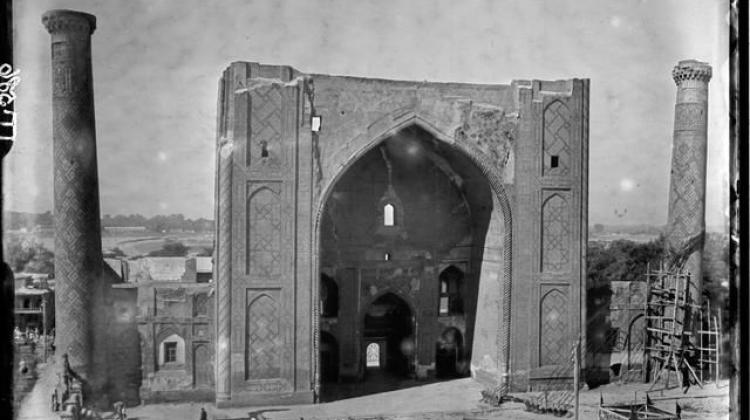
Ernst Cohn-Wiener, Photo of the Madrasah-i Ulugh Beg in Samarkand, 1924-25
Source: The British museum
Free and open to the public Live stream link forthcoming
The “waqf question” in Soviet Turkestan and Architectural Restoration
Abstract
In the early Soviet period, the preservation of Islamic architecture in Central Asia became entangled with a struggle over the property and revenues that had historically sustained it. This talk examines the relationship between Islamic charitable endowments and Soviet preservation agencies in Samarkand between 1922 and 1927, focusing on the activities of the Samarkand Commission for the Preservation and Restoration of Monuments and its parent institution, Turkomstaris. Facing chronic shortages of funding, Turkomstaris sought access to waqf revenues traditionally used to support mosques, madrasas, and shrines. Their claims brought them into conflict with the newly established Soviet waqf administration, as well as local Muslim communities and custodians of endowed property. These disputes raised fundamental questions about who controlled waqf resources, who had authority over Islamic buildings, and what constituted legitimate restoration. Drawing on archival records, administrative correspondence, and local press, the talk explores how preservationists, Soviet officials, and Muslim communities negotiated competing claims to waqf and architectural heritage and what argumentative strategies they used.
Bio
Anna Pronina is a cultural historian, curator, and researcher of the Soviet Union, specializing in Central Asia. She received her PhD in History from Central European University (Vienna). Her dissertation, Crafting Socialist Realism: Heritage, Materiality, and Expertise in Soviet Uzbekistan, 1930s–1950s, examines the production of architecture, opera, ballet, and visual arts in Soviet Uzbekistan, arguing that Socialist Realism emerged through negotiations among local experts, Soviet-trained professionals, and state institutions rather than through unilateral directives from Moscow. By foregrounding local knowledge and heritage, the study reconceptualizes Socialist Realism as a flexible and contested mode of cultural production. She co-curated the exhibition Split Together, Merged Apart (GES-2, Moscow, 2025), which examined Soviet archaeology and restoration practices in Central Asia, and served as an academic advisor to the first Bukhara Biennial of Contemporary Art. As an Aga Khan Fellow at MIT, Pronina is researching the social history of architectural restoration in Soviet Uzbekistan,focusing on the role of local craftsmen and restoration expertise. Her broader research interests include architecture, restoration, performing arts, nation-building, cultural policy, the circulation of images and objects, and environmental history in Soviet Central Asia.