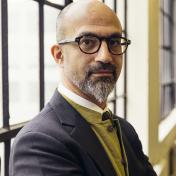





John E. Fernández
John E. Fernández ‘85 is a full professor of architecture, urbanism and building technology in the Department of Architecture at MIT. He is co-founder of MIT Environmental Research + Action (ERA). ERA was created to advance knowledge and real-world solutions that promote the sustainability of cities, enhance the protection and stewardship of ecosystems in partnership with local communities, and develop and deploy digital technologies for a humane, prosperous and climate safe future. ERA represents a new model for environmental research and action — uniting cities, the biosphere, and artificial intelligence as co-evolving systems that are delineating the trajectory of the planet in the 21st century.
Since joining the MIT faculty in 1999, Fernández has led two research labs, the Emergent Materials Group (EMG) and the Urban Metabolism Group (UMG). The EMG has explored the material needs of a sustainable built environment. The UMG has pioneered methods to understand the resource intensity of global cities and the relation between material and energy flows and climate change, biodiversity and novel approaches to infrastructure for a sustainable planet.
Fernández is author of two books, Material Architecture (Routledge) and Sustainable Urban Metabolism (MIT Press). He is currently completing his third book on the role of cities in global resource flows, climate change and biodiversity. He has published on a wide range of subjects including energy and sustainable buildings, urban metabolism, construction materials, infrastructure and cities, urban biodiversity, resource efficient design and more, in scientific and design journals including Science, Ambio, the Journal of Industrial Ecology, Building and Environment, Energy Policy, Energy & Buildings, Energies, Energy Procedia, and Sustainability.
From 2015-2024, Fernández was the director of a MIT Presidential Initiative and the institute’s largest environmental research and action-oriented program, the Environmental Solutions Initiative (ESI). As director of the ESI he oversaw diverse research efforts including mining and a circular economy, cities and climate change, plastics and the environment, natural climate solutions, climate justice and more. The ESI served to enable and connect MIT students, faculty and staff with urgent needs and timely engagement on an array of environmental challenges. Fernández and his staff brought innovations to this effort including the Rapid Response Group and the undergraduate minor in Environment and Sustainability. In 2025, Fernández was awarded the Gordon Y. Billard Award, given for special service of outstanding merit performed for the Institute.
From 2011-2015, Fernández was co-Director of the MIT-Singapore University of Technology and Design International Design Center and from 2012 to 2015 Head of Architecture and Sustainable Design. Fernández also served as Director of the Building Technology Program in the Department of Architecture from 2010 to 2015. Before that he directed the Sustainable Energy research effort of the MIT Portugal Program.
He is frequently invited to speak at academic conferences, government proceedings, corporate events and other functions on subjects from climate change and the built environment, urban metabolism and sustainable cities to the carbon footprint of the music industry to the evolution of strategies for businesses and other organizations oriented toward an environmentally positive future for people and non-human species. He has spoken at events organized by the United Nations, subcommittees of the US Congress, agencies of the US Federal government, the European Union, several foreign governments, and dozens of companies.
Fernández has served as Chair of Sustainable Urban Systems for the International Society of Industrial Ecology and served as Associate Editor of the journal Sustainable Cities and Society. He has served on several boards and advised numerous organizations including the World Economic Forum on Biodiverse Cities by 2030, the Center for Sustainability of the Fraunhofer Institute, Ocean Visions, Earth Percent, the US Environmental Protection Agency, the US Department of Commerce, the US State Department, the US Department of Energy Advanced Research Projects Agency, the UN Environment Program, UN Habitat, the US Green Building Council and numerous corporate leaders and members of the C-suite. In 2025 Fernández was appointed by the Governor of the Commonwealth of Massachusetts to serve on the Embodied Carbon Intergovernmental Coordinating Council in the development of an approach to legislation governing embodied carbon in the construction sector.
Fernández currently serves as the Strategy Advisor to Lamarr.AI, a leading global startup serving to improve the energy efficiency of buildings through machine learning, computer vision and drones. He has been a practicing architect since 1991 and regularly advises on groundbreaking sustainable building design and construction – the latest being the world’s largest Passive House commercial office building located in downtown Boston.
Since 2015, Fernández and his wife, Malvina Lampietti have lived on campus as Heads of House at Baker House, one of MIT’s largest undergraduate residence halls.