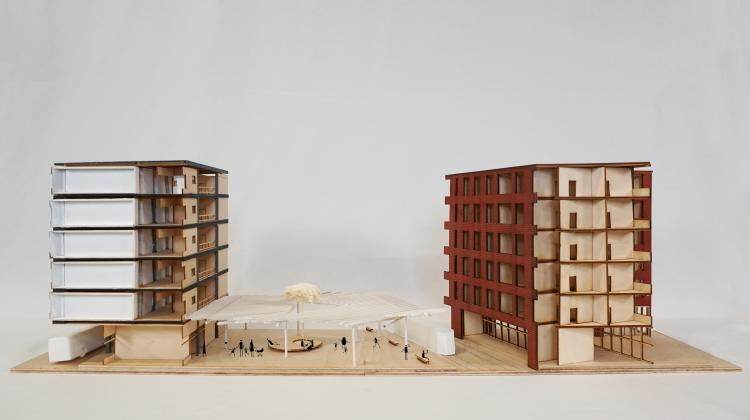





Juchen Zhang
Juchen Zhang is a master’s student in the History, Theory and Criticism of Architecture and Art (HTC) program at MIT, whose research examines ethnic enclaves in American cities during postwar urban renewal, using public housing development in Chinatowns as a key entry point into these broader questions. His ongoing investigation of inhabitant agency in mass housing is evident in his publication in PLAT journal, which proposes a revisionist view of East German prefabricated communities, and his M.Arch. thesis on the impact of rapid urbanization on rural living in his hometown, Hefei, China. Juchen has engaged in professional practice, teaching, and exhibition work, with degrees in architecture from the University of California, Berkeley, and Rice University.
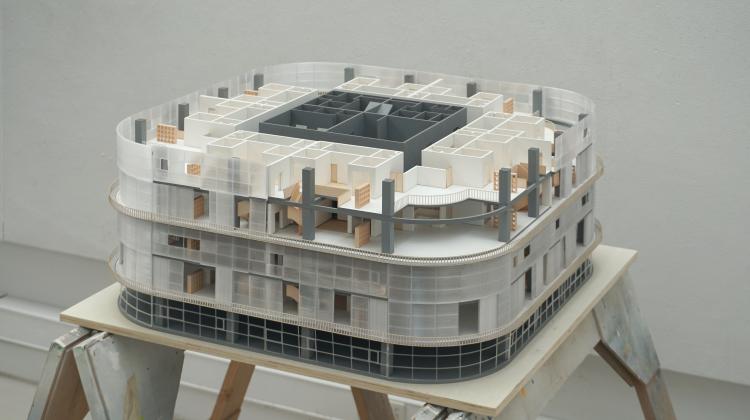
“Towers of Skywells” proposes to repurpose incomplete office towers--part of the same development, later abandoned due to legal, economic, and political complications--as a new form of hybrid dwelling for displaced farming families. The project operates on two levels. In terms of design, it extrapolates historic regional housing typologies to spatially reconstruct the familial and communal networks fragmented by high-rise living. It then situates this architectural intervention within a speculative-ground-up economic model of acquisition and collective ownership, envisioning a potential return to forms of rural living within a post-urbanization landscape.
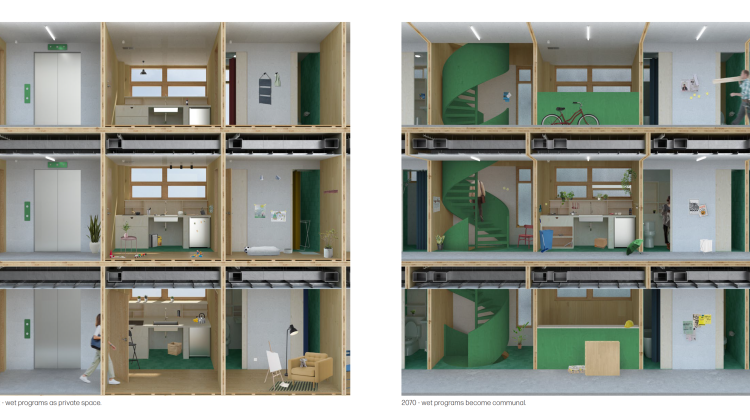
By 2070, increasing precipitation will have displaced a large population from low-lying neighborhoods as the city “tropicalizes.” Thus, the building has a system of change based on how water can help organize living in a denser, wetter future. A “wet wall” consolidates the wet programs into a continuous band that runs alongside the slab building, allowing them to become communal when the organization of housing shifts to create a dense co-living environment. By doing so, the building also facilitates a return to a collective culture around water, where the wet programs become a space of socialization.