


Trang Nguyen

Trang Nguyen is an architectural designer with a focus on post-industrial landscapes, environmental visualization, and infrastructural ecologies. She earned her Bachelor of Architecture from Cornell University in 2025, where she was awarded the Edwin A. Seipp Prize and the Addison G. Crowley (B.Arch. '38) Prize for design excellence.

At Cornell, Trang worked as a research assistant at the Design Across Scales Lab for three years, creating visualizations that examined the spatial impacts of oil extraction. Her thesis investigated the rehabilitation of Minnesota’s Mesabi Iron Range, proposing new futures for its taconite mining legacy. She also worked at Höweler + Yoon Architecture, contributing to the design of an elementary school project in Columbus, Indiana.

Trang is currently pursuing a postgraduate degree in Architecture and Urbanism at MIT. Her work explores how urban design can rescale the human experience within complex post-industrial landscapes.
Projects
Growing the South Bronx
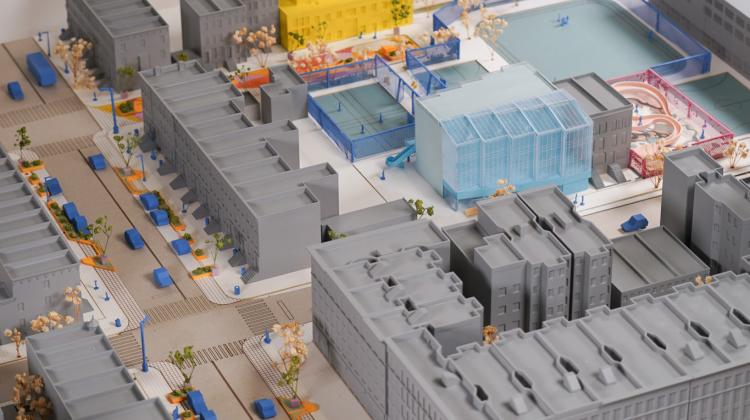
A community driven urban design project developed in collaboration with South Bronx Unite and the Community Land Stewards. The project contributes to a feasibility study that explores sites with the potential to expand the local community land trust through services and infrastructure that support environmental and economic justice. Located in the heart of Mott Haven, the project connects three adjacent sites embedded within the existing urban fabric, including the 40th Precinct Police building on Alexander Avenue, an underutilized parking lot along East 139th Street, and a vacant lot adjacent to Willis Playground and a nearby elementary school. Through a series of community engagement meetings with residents of the South Bronx, the project identified recurring concerns such as the lack of accessible green space, limited gathering areas, and insufficient access to fresh food. These priorities informed the development of proposed programs, including a community market space, a makerspace, and an interactive playscape. By grounding its design proposals in direct community input, Growing the South Bronx demonstrates how participatory planning can transform overlooked sites into shared spaces that support community life.
Territories of Oil
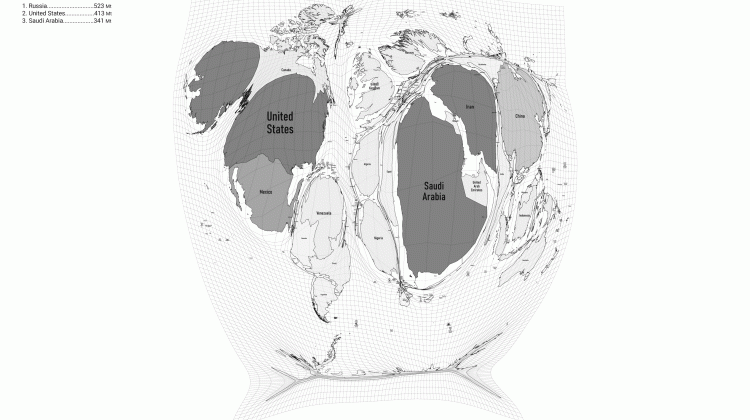
This cartographic project maps global oil production to reveal the geographic distribution of petroleum extraction and its relationship to political power and resource control.
Re(Source) A dystopian World
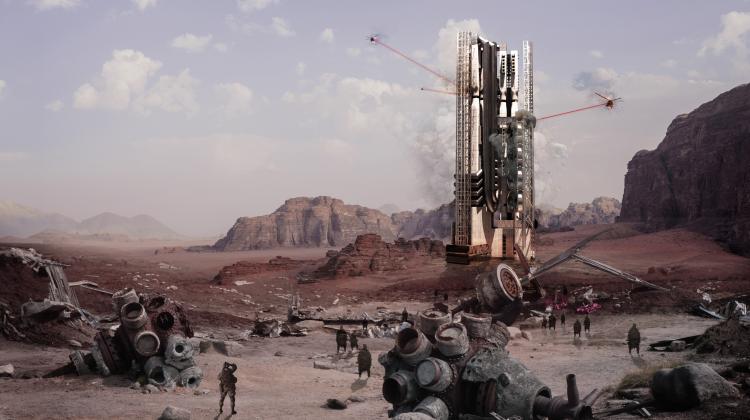
This imaginary manifesto project envisions a near future in which climate collapse and relentless resource extraction have transformed the planet into a vast machine landscape. As pollution renders the outdoors nearly uninhabitable, human life shifts indoors and into the digital realm, where work, social life, and education take place through virtual avatars. Hidden within mountains and former open-pit mines, massive data centers power this new world and are controlled by powerful technology corporations that govern a society dependent on information. In this landscape, data has become the most valuable resource on Earth, surpassing oil and water, and control over it defines political and economic power. The project imagines a growing contestation over these infrastructures of data between corporations that seek to consolidate control and emerging groups that question their dominance and advocate for reclaiming both information and the damaged landscapes of the physical world.
Cuddled Objects // Exhibition
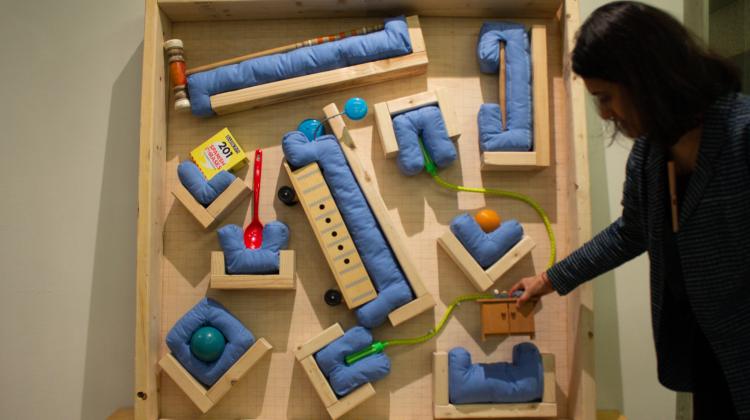
It is a wall, but not quite a wall. The design proposes filling the cavity wall with objects nestled within “insulation.” The objects were sourced from Ithaca Reuse, creating a repository of lost items. Measured within a one-inch grid, the objects are laid out and displayed. A blue fabric filled with polyfill is inserted underneath to give each object a sense of importance. Finally, individual 2×4 wood pieces are cut to support each item. Visitors are encouraged to take the objects.