


Mateo Fernandez

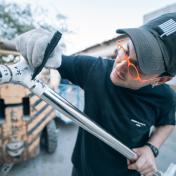
Mateo Fernandez is a designer, researcher, and tinkerer working across disciplines and scales. His work ranges from developing new living biomaterials for construction on Earth to designing self-assembling habitats for the Moon, and everything in between, including spacesuits, freestanding compression structures, cities, and submarines. The only thing that guides his work is discovery, much of which he attributes to his early years as a magician. His professional experience also reflects his wide-ranging interests, having worked for sculptors, architects, and technology companies such as theverymany, Bjarke Ingels Group, Tatiana Bilbao Estudio and ICON 3D Printing. He holds a Master of Architecture from MIT and a Bachelor of Fine Arts from SCAD. He was also a 2024 MAD Fellow.
Projects
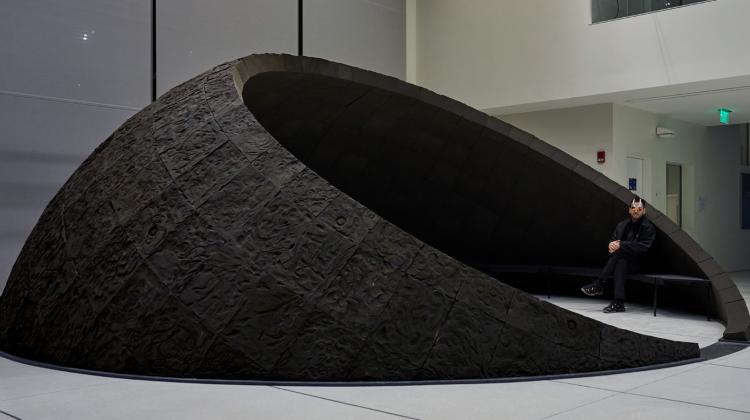
Luna is a moon-inspired masonry dome that serves as a mission control room for a unique lunar landing mission, employing novel construction techniques to balance structural efficiency and sustainability. The dome is constructed from foamed-glass blocks, a lightweight, easily machinable material that ensures compliance with the load-bearing limits of the floor beneath. No mechanical connections or mortar are used, enabling a no-tension assembly of interlocking blocks. By discretizing the geometry into optimized segments, the structure enables rapid construction with minimal formwork, reducing material waste and labor intensity. Designed with modularity in mind, the dome can be disassembled, relocated, and reassembled.
Project Designer: Mateo Fernandez
Structural Lead: Nebyu Haile
Fabrication Lead: Simon Lesina-Debiasi,
Project Team: Nof Nathansohn Jared Laucks, Farida Moustafa, Arzy Abliadzhyieva
Faculty Advisors: John Ochsendorf,, Brandon Clifford, J. Roc Jih, Skylar Tibbits
WoodSpray
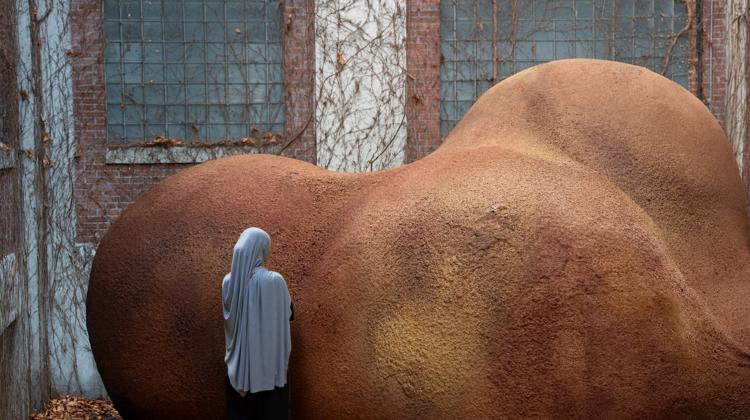
The construction industry is a major contributor to global carbon emissions, while sawmilling generates an enormous and underutilized waste stream in which 45–55% of each harvested tree becomes sawdust, chips, or bark that is typically burned, landfilled, or bound into low-value composites. WoodSpray proposes a new pathway for this overlooked material: transforming wood waste into a sprayable, biodegradable structural composite made from sawdust, lignin, and nanocellulose. Applied robotically over reusable formwork, the material offers a faster, healthier, and substantially lower-carbon alternative to petrochemical products.
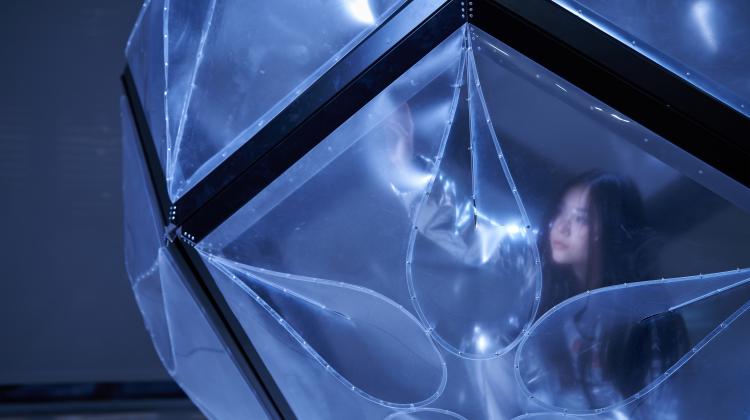
Momo, a collaborative project by MIT’s Department of Architecture, AeroAstro, and the MIT Media Lab, aims to create a self-assembling lunar habitat. The habitat’s driving design objectives are twofold: first, to maximize the efficiency of flat-packing the habitats into Starship HLS cargo space, and second, to ensure modularity. Each module is constructed from an aluminum frame and a high-density polyethylene membrane to protect against radiation. These modules contain storage space and can be customized depending on their function, serving as an airlock, a window, a PV panel, a work desk, or an exercise module. Additionally, they are replaceable in case of a breach, allowing astronauts to swap a module instead of replacing the entire extraterrestrial habitat.
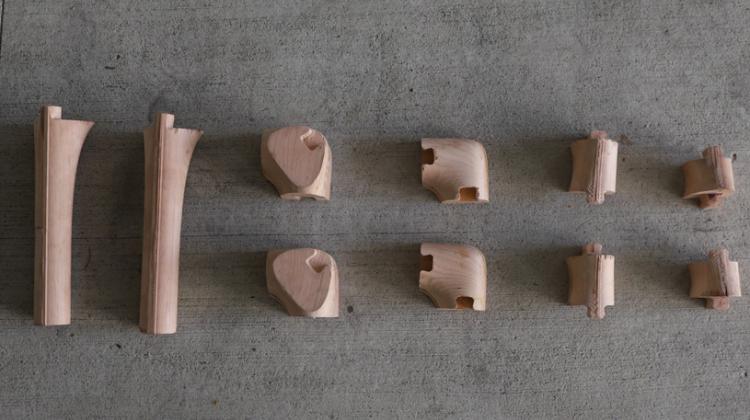
The Homie Stool intertwines the artistry of CNC milling and woodworking with the precision of robotics. The project emerges as a beacon of hope in an era marked by rapid technological advancements, where a pervasive sense of uncertainty and apprehension has taken hold. Transcending beyond traditional seating, Mateo Fernandez, Yiqing Wang, and Justin Brazier’s design’s significance lies in its ambition to reimagine and celebrate the essence of human connection. By inviting individuals to sit back-to-back, it fosters an intimate and engaging environment. As they lean on each other for support, a connection is forged and conversations flow. ‘It serves as a gentle reminder that human connection and interaction are the essence of our existence,
Hi-Fi Suit
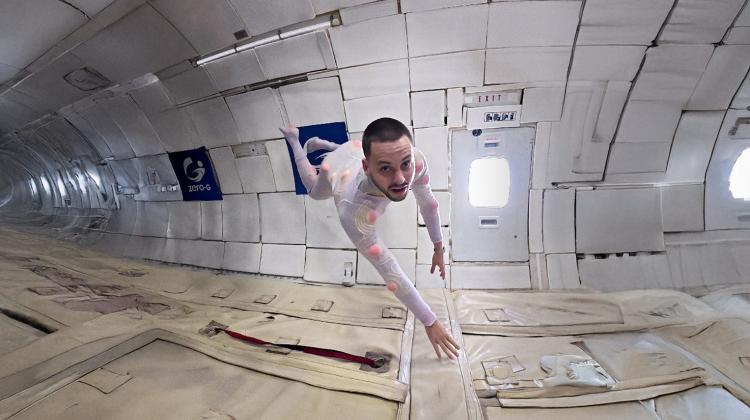
The High Frequency suit is an Intra vehicular space suit designed to support astronauts by serving as a passive aid to minimize muscle atrophy and bone density loss. The suit integrates vibration nodes positioned along key muscles and bones, all connected through TPU “highways” that distribute the vibrations evenly across the body. Maintaining a constant 40 Hz vibration, the system helps stimulate musculoskeletal health during missions. Its purpose is to reduce the amount of exercise astronauts must perform in space, maximizing efficiency while still protecting their bodies and, ultimately, enabling the possibility of longer missions.
Post Carbon Future
CORE III
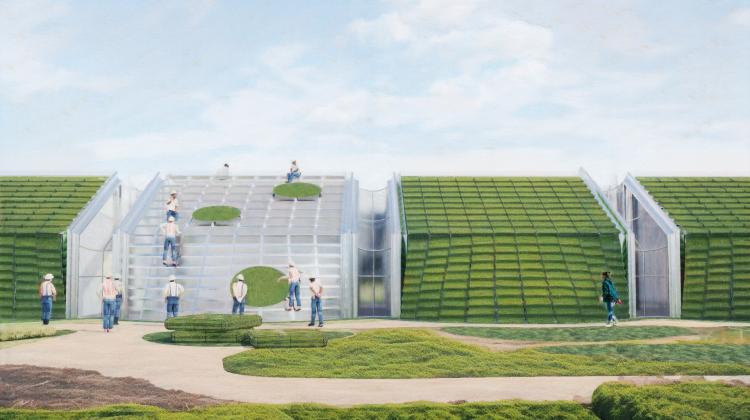
Imagine a world where streets don’t smell of oil or fumes, where buildings are only as healthy as the land they sit on, where supply chains shorten and we depart from petrochemical-derived products. Post Carbon Future is a provocation to do just that by developing a series of buildings made from different biomaterials
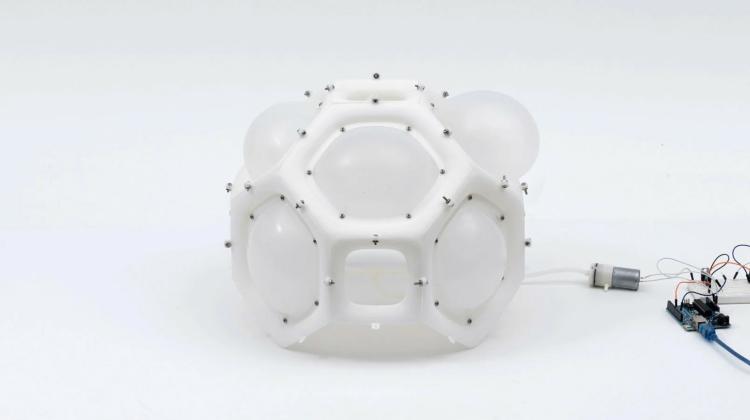
The anthropomorphic machine acts as a pulsating organ pressing against its ribcage while simultaneously being the ventilator providing it with air through a series of tubes. ‘The slow cadence of air fluctuating through the machine mimics that of a patient on a hospital gasping for air, every time less and less and less’. With the rapid development of artificial intelligence and the Covid pandemic in our rear mirror, the object seeks to project the past of a world shut down by a pandemic through breathing onto its speculative future, a world dictated by breathing machines.
Hugging Tree Bench
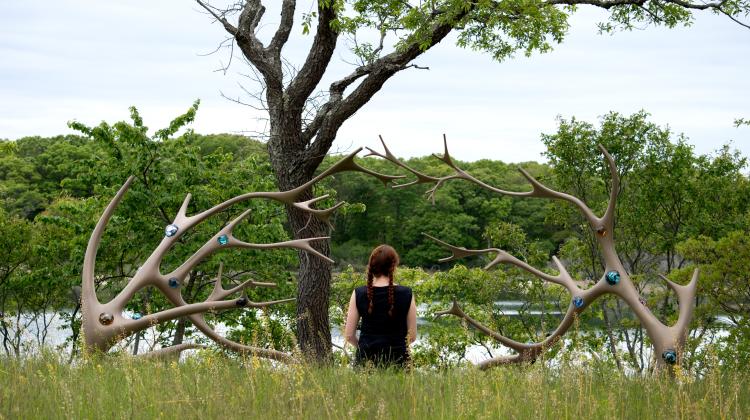
The bench was designed to serve as a lookout that blends seamlessly with its natural surroundings. At first glance, it appears to be just another tree in the forest. But as you approach, you notice it shines. Drawing closer, you realize the shimmer comes from embedded gems, and a magical, otherworldly tree begins to unfold before your eyes. Made with casted bronze and blown glass
Publications