




Sam Owen
Sam Owen is a designer, urban researcher, and time traveler with a special interest in regenerative urban design through the lens of systems ecology. As a candidate in the Master of Science in Architecture Studies (SMArchS) program, his research is grounded in a nuanced and localized understanding of the climate crisis, challenging humanity’s relationship with our natural world and looking ahead to the urban resilience challenges that humanity will face in the 21st century and beyond. His research asks: “How might humanity transition from apex predators into apex stewards of the landscapes we inhabit?”
This question serves as the backbone of Sam’s ongoing thesis research, A Time Traveler’s Guide to the West After Water, which is a speculative design project to explore how the parched Desert Southwest might continue to be co-inhabited by humans and nonhumans alike in an impending future where climate change and over-extraction have caused the region's water supplies to collapse.
Sam is also a co-founder of CommonGround, a digital platform to promote a social movement around hyper-local climate actions. Using behavioral science, gamification, and AI-supported recommendations, the platform matches people to real-world actions in their local community, making climate engagement more accessible, inviting, and hopeful.
Last year, Sam’s work was exhibited at the 15th International Conference on the Constructed Environment and as part of MIT’s Climate Work: Un/Worlding the Planet exhibition at the 2025 Venice Architecture Biennale. This year, his work is set to be featured in the Harvard Urban Review.
Prior to MIT, Sam was an architect at desertWORKS Studio and a research assistant at the University of Arizona, publishing grant-funded projects including a collaboration with the College of Astronomy to develop a novel fabrication method for double-curved aluminum panels. He was also a key contributor to Re-membering the CIV (Centre d’Identification de Vincennes), an AR and video installation to speculate on how a site-specific event can expand engagement with the phantom CIV into an embodied, collective, performative, and spatial act of re-membering. During his time at the UA College of Architecture, he also sat on reviews and assisted with design studios in the graduate program.
Sam holds a Bachelor of Architecture from the University of Arizona, graduating magna cum laude from the W.A. Franke Honors College.
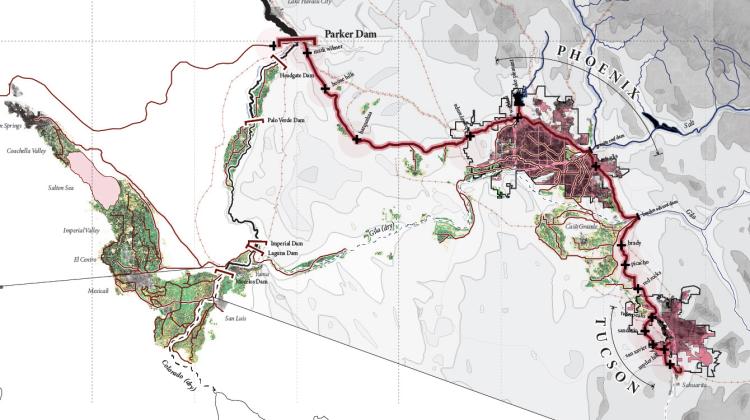
This project is currently in progress as part of the Contemporary Urbanism Proseminar, under the instruction of Rania Ghosn.

To become a resilient city, the Phoenix metro needs to cut ties with the Central Arizona Project, which provides 36% of the city’s water demand while holding it hostage to changing rainfall patterns across one of the continent’s most drought-prone watersheds.
This dependence would be negated by capping the metro population at 3 million - placing PHX in alignment with the carrying capacity of our local Salt/Verde water system. Next, the PHX metro can refocus development on two urban cores concentrated on existing population centers (Tempe + Downtown Phoenix), both densified over time into transit-first walkable communities.

Winner of The Capstone Award (2022), Capstone Distinguished Project (2022), and exhibited at AIA Arizona State Conference (2022)
How can cities transition from the world’s largest importers, polluters, and waste generators into centers for production and waste reclamation?
This proposal advocates for Barcelona to refocus investment away from vague “innovation centers” and back into self-sufficient neighborhood economies built on cooperative production and the Catalan vaulting tradition.
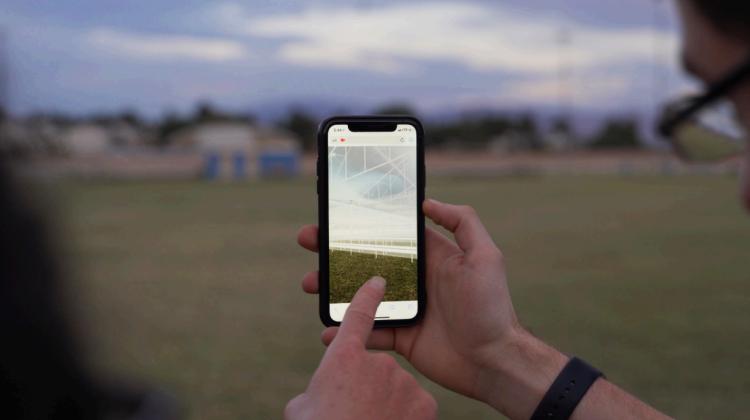
I assisted Dr. Beth Weinstein with the creation, texturing, and AR implementation of the 3D camp model based on historical drawings and imagery, and also created a video walkthrough of the camp as a supplement to the AR exhibit. This work was published as conference proceedings for the ACSA 2022 Empower Conference.