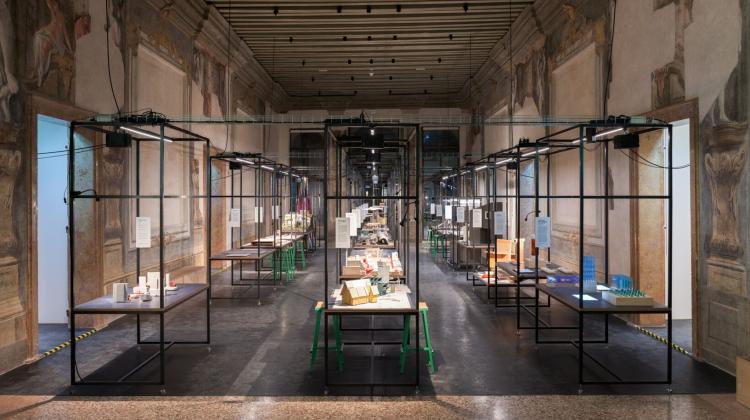



4.501

Tiny Fab: Advancements in Rapid Design and Fabrication of Small Homes

Introduces digital fabrication as a method of home, hut, and shelter delivery/construction. Explores the progression of industrial-based building production from prefab to digital fab. Examines new computational techniques for rapid construction, as well as the basics of tiny building design, 3D modeling systems, scalable ways to prototype, and computer numerical control (CNC) fabrication. Students use lab time to design a prototype of a small building as a single packaged product. Additional work required of students taking graduate version. Lab fee required. Enrollment limited.

Spring
2026
4.501: 2-3-7
U
Schedule
T 9-12
Location
1-136
Prerequisites
UG: 4.500
Restricted Elective
UG: BSA, BSAD, Arch Minor, Design Minor
Enrollment
Limited
Preference Given To
Course 4 majors and minors
Lab Fee
Required
Can Be Repeated for Credit
No
Document Uploads
4.589

Preparation for Design and Computation PhD Thesis

Selection of thesis topic, definition of method of approach, and preparation of thesis proposal in computation. Independent study supplemented by individual conference with faculty.

Advisor
Spring
2026
TBA
G
Schedule
see advisor
Prerequisites
permission of instructor
Required Of
PhD Comp
Can Be Repeated for Credit
Yes
4.588

Preparation for SMArchS Computation Thesis

Students select thesis topic, define method of approach, and prepare thesis proposal for SMArchS Computation degree. Faculty supervision on a group basis. Intended for SMArchS Computation program students, prior to registration for 4.ThG.

Advisor
Spring
2026
2-0-4
G
Schedule
see advisor
Required Of
SMArchS Computation
Can Be Repeated for Credit
No
4.557
MAS.552

City Science — Beyond Zoning: Towards a New Urban Operating System

Zoning has become the city’s hidden operating system—the invisible code that dictates how urban life unfolds.

It determines where and how people live, work, shop, learn, and move. It shapes the supply and cost of housing, the character of neighborhoods, access to everyday amenities, and the prospects of local businesses.

But today’s cities confront overlapping crises: climate risk, housing scarcity, infrastructure strain, demographic shifts, and the reconfiguration of work, retail, learning, and healthcare that is upending traditional urban anchors. The zoning frameworks inherited from the 20th century—built for stability and uniformity—are increasingly misaligned with the volatility and urgency of the 21st. What cities need now is not incremental reform, but a new, responsive operating system for urban life.

Course Focus: Students will investigate a radical alternative to static zoning—a dynamic, incentive-based, pro-social framework that treats the city as a living system. This model channels market forces through feedback loops, much like a natural ecosystem, to cultivate what we call civic homeostasis: a state of balance that adapts as conditions change.

San Francisco is now undergoing radical zoning reform, and the City Science group is collaborating with city leaders to help communities understand its impact, and to explore what comes beyond zoning. Students in the class will have the opportunity to contribute directly by:

  • Analyzing urban data—from mobility flows and land use to demographic shifts—to decode the hidden patterns shaping communities today.
  • Building simulations—both top-down statistical models and bottom-up agent-based systems—to test how interventions ripple through the social, economic, and environmental fabric of the city.
  • Designing dynamic incentive structures to balance housing, workplaces, and daily amenities, while exploring how an AI Urban Advisor could provide city supervisors with continuous feedback—an early form of augmented intelligence for urban governance.
  • Prototyping a CityScope platform to foster transparent, participatory community engagement.
  • Experimenting with parametric design and generative AI tools as engines for reimagining urban rules and forms.

Deliverables: Weekly assignments, mid-term, and final project.

Teaching Collaborators: Maitane Iruretagoyena (Technical Associate), Yasushi Sakai, (Research Scientist), Markus Elkatsha (Research Scientist)
Website: https://www.media.mit.edu/courses/mas-552-city-science-beyond-zoning/

Kent Larson
Fall
2025
3-0-9
G
Schedule
W 1-4
Location
E15-341
Can Be Repeated for Credit
Yes
4.589

Preparation for Design and Computation PhD Thesis

Selection of thesis topic, definition of method of approach, and preparation of thesis proposal in computation. Independent study supplemented by individual conference with faculty.

Advisor
Fall
2025
TBA
G
Schedule
see advisor
Prerequisites
permission of instructor
Required Of
PhD Comp
Can Be Repeated for Credit
Yes
4.588

Preparation for SMArchS Computation Thesis

Students select thesis topic, define method of approach, and prepare thesis proposal for SMArchS Computation degree. Faculty supervision on a group basis. Intended for SMArchS Computation program students, prior to registration for 4.ThG.

Fall
2025
2-0-4
G
Schedule
T 3-6
Location
3-329
Required Of
SMArchS Computation
Can Be Repeated for Credit
No
4.583

Forum in Computation

Group discussions and presentation of ongoing graduate student research in the Computation program.

Fall
2025
3-0-0
G
Schedule
W 5:30-7
Location
5-231
Prerequisites
Permission of instructor
Can Be Repeated for Credit
Yes
4.581
4.582

Proseminar in Computation / Research Seminar in Computation

4.581 Proseminar in Computation (G) / 4.582 Research Seminar in Computation (G)

Introduction to traditions of research in design and computation scholarship.

4.582 Research Seminar in Computation

In-depth presentations of current research in design and computation.

Fall
2025
3-0-9
G
Schedule
T 9:30-12:30
Location
5-232
Prerequisites
4.581: permission of instructor; 4.582: 4.580 or permission of instructor
Required Of
PhD Design and Computation
Can Be Repeated for Credit
Yes
4.580

Inquiry into Computation and Design

Explores the varied nature, history and practice of computation in design through lectures, readings, small projects, discussions, and guest visits by Computation group faculty and others. Topics may vary from year to year. Aims to help students develop a critical awareness of different approaches to and assumptions about computation in design beyond the specifics of techniques and tools, and to open avenues for further research.

Fall
2025
3-0-9
G
Schedule
T 9:30-12:30
Location
5-231
Prerequisites
permission of instructor
Required Of
SMArchS Computation
Can Be Repeated for Credit
No